Sun–Earth–Moon Motions: Visualising Celestial Movements
Explore the linked motions of the Sun, Earth and Moon with adjustable 2D and 3D visualisations. Understand Earth's rotation, revolution, and the Moon's orbit to enhance teaching of celestial mechanics.
Want to teach with this content in Prezuva Slide?
Prezuva — Create, Teach, Engage, Assess
Try for free →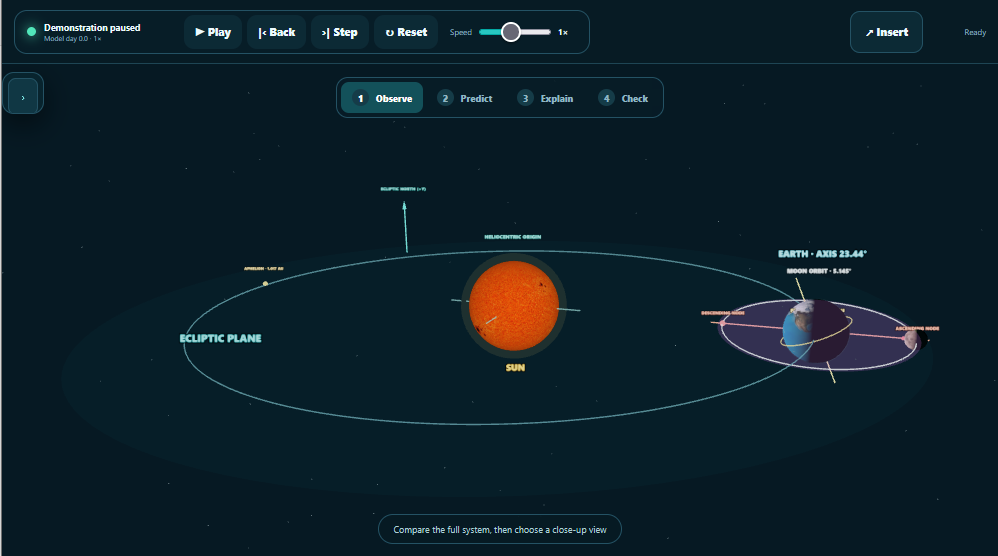
For individual learning only. Use for classroom teaching or commercial purposes is not permitted.
About this classroom tool
The Sun–Earth–Moon Motions classroom tool provides an interactive way to visualise the complex movements of these celestial bodies. It allows teachers and students to explore Earth's rotation on its axis, its revolution around the Sun, and the Moon's orbit around Earth in both 2D and 3D views. This visualisation helps clarify how these motions relate to time cycles such as day, month and year.
By adjusting time controls and switching between different teaching views, educators can demonstrate key concepts like orbital planes, axial tilt, and the changing relative positions of the Sun, Earth and Moon. This makes understanding celestial mechanics more accessible and engaging for learners across all ages and subjects including geography, earth science and astronomy.
Key concepts
- Earth's Rotation — the spinning of Earth on its axis, causing day and night.
- Earth's Revolution — Earth's orbit around the Sun, defining the year.
- Moon's Orbit — the path the Moon takes around Earth, influencing lunar phases.
- Orbital Planes — the flat surfaces in which Earth and Moon orbit, explaining eclipses and nodes.
- Axial Tilt — the angle of Earth's axis, responsible for seasons.
Using it in the classroom
- Starter activity: Use the tool to introduce day and night by showing Earth's rotation.
- Whole-class teaching: Demonstrate the relationship between Earth's revolution and the calendar year.
- Assessment for learning: Ask students to predict Moon phases based on its orbit visualisation.
- Homework: Assign students to explore how axial tilt affects seasons using different views.
- Group discussion: Analyse how orbital planes explain eclipses and nodes.
Frequently asked questions
How does Earth's rotation affect day and night?
Earth's rotation on its axis causes different parts of the planet to face the Sun or move away from it, resulting in day and night cycles.
What is the difference between Earth's rotation and revolution?
Rotation is Earth spinning on its axis once approximately every 24 hours, while revolution is Earth's orbit around the Sun, which takes about 365 days.
Why does the Moon have phases?
The Moon's phases result from its orbit around Earth, changing the visible portion of its sunlit side as seen from Earth.
What are orbital planes and why are they important?
Orbital planes are the flat surfaces in which celestial bodies orbit; understanding them helps explain phenomena like eclipses and the points where orbits intersect called nodes.