Solar System Classroom Tool: Explore Planetary Orbits and Sizes
Discover the Solar System with animated orbits and comparative views of planets’ sizes, distances, and rotations. Ideal for teaching planetary science across all grades.
Want to teach with this content in Prezuva Slide?
Prezuva — Create, Teach, Engage, Assess
Try for free →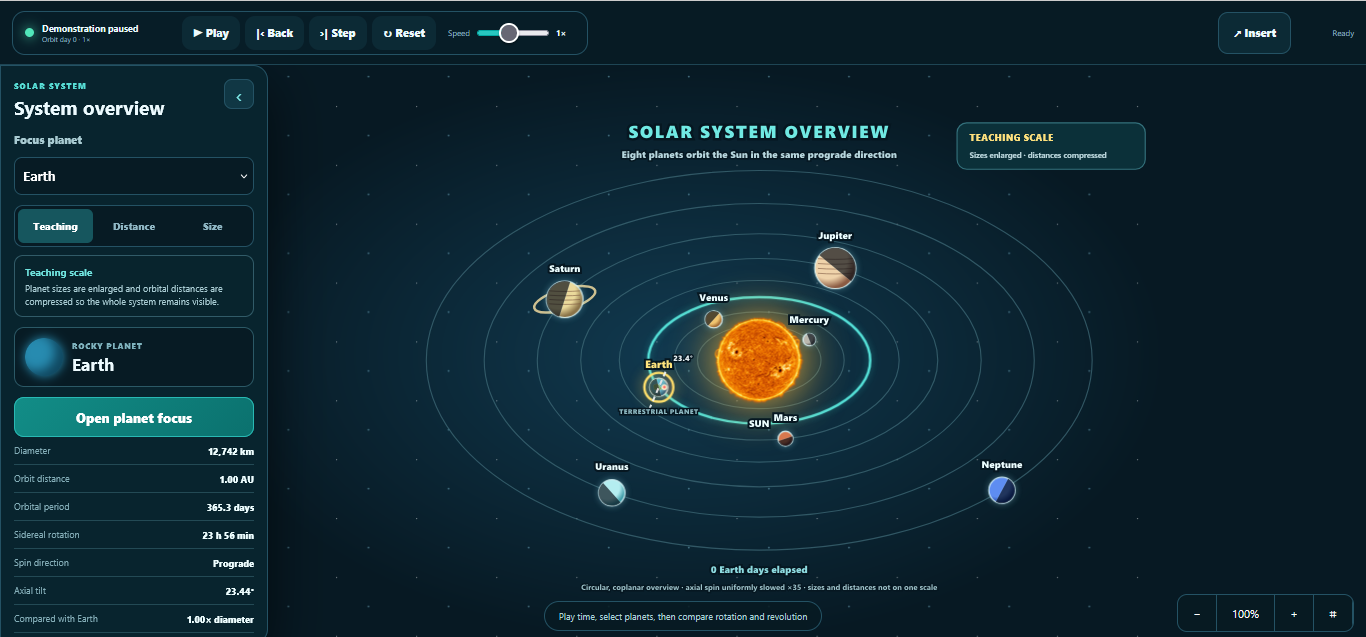
For individual learning only. Use for classroom teaching or commercial purposes is not permitted.
About this classroom tool
This Solar System classroom tool provides an interactive way to explore the planets and their movements around the Sun. It features animated orbits, allowing students to visualise how planets revolve and rotate, enhancing understanding of planetary motion.
Using comparative views, the tool illustrates the relative sizes and distances of the planets, helping learners grasp the vast scale of our Solar System. It also distinguishes between rocky terrestrial planets, gas giants, and ice giants, supporting cross-disciplinary learning in science and geography.
Key concepts
- Planetary Orbits — the paths planets follow as they revolve around the Sun.
- Orbital Period — the time a planet takes to complete one orbit around the Sun.
- Rotation Period — the time a planet takes to spin once on its axis.
- Planetary Sizes — comparative scale of planet diameters within the Solar System.
- Planet Types — classification into rocky terrestrial planets, gas giants, and ice giants based on composition.
Using it in the classroom
- Starter Activity: Introduce the Solar System by observing animated orbits to spark curiosity about planetary motion.
- Whole-Class Teaching: Use comparative size and distance views to explain scale and composition differences among planets.
- Assessment for Learning: Have students predict orbital and rotation periods, then check using the tool’s animations.
- Homework: Assign students to research one planet’s features and present how it compares to others using the tool.
Frequently asked questions
What is the difference between orbital period and rotation period?
The orbital period is the time a planet takes to orbit the Sun once, while the rotation period is the time it takes to spin once on its own axis.
Why are some planets called gas giants and others terrestrial?
Terrestrial planets are rocky and solid, like Earth and Mars, whereas gas giants are large planets mostly made of gases, such as Jupiter and Saturn.
How does this tool help students understand distances in space?
The tool uses scaled distances to visually represent how far planets are from the Sun and from each other, making vast space distances easier to comprehend.