Seasons: Understanding Earth's Axial Tilt and Orbit
Explore why seasons occur through Earth's axial tilt and orbit. Learn about sunlight angles, daylight duration, solstices, equinoxes, and seasonal differences across hemispheres.
Want to teach with this content in Prezuva Slide?
Prezuva — Create, Teach, Engage, Assess
Try for free →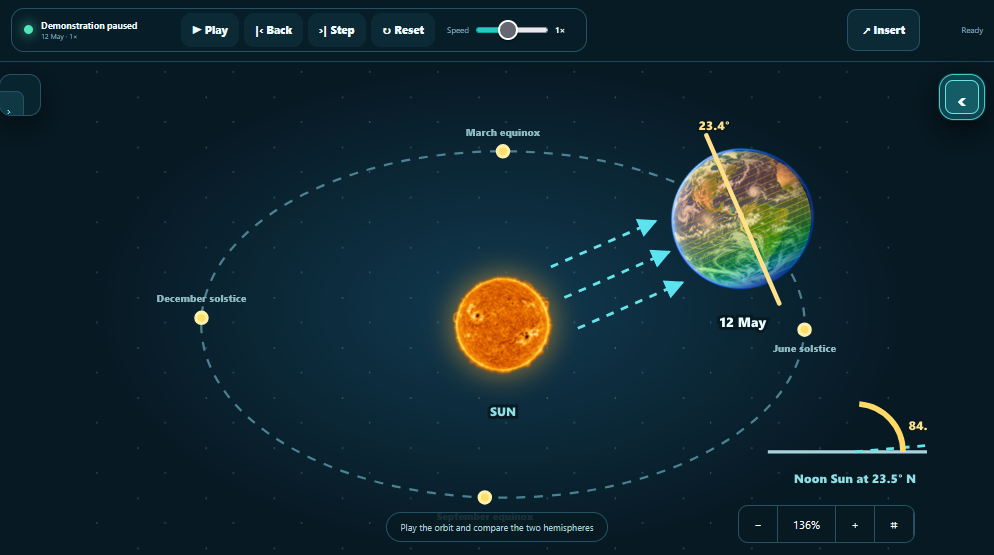
For individual learning only. Use for classroom teaching or commercial purposes is not permitted.
About this classroom tool
Seasons result from Earth's axial tilt and its revolution around the Sun. As Earth orbits, the tilt causes varying angles of sunlight and changes in daylight duration, leading to seasonal temperature and weather differences.
This tool illustrates how sunlight angle, solar radiation, and day length vary across latitudes and hemispheres throughout the year. It also explores key astronomical events such as solstices and equinoxes that mark seasonal transitions.
By visualising Earth's orbit and tilt interactively, teachers and students can deepen their understanding of why seasons occur and how they differ between the Northern and Southern Hemispheres.
Key concepts
- Axial tilt — Earth’s axis is tilted about 23.5°, causing seasonal changes.
- Earth’s revolution — Earth orbits the Sun once each year, changing sunlight exposure.
- Sunlight angle — The angle of sunlight affects heating and varies with latitude and season.
- Daylight duration — The length of day changes throughout the year, influencing temperature.
- Solstices and equinoxes — Key points in Earth’s orbit marking seasonal start and day length changes.
Using it in the classroom
- Starter activity: Use the tool to demonstrate Earth’s tilt and orbit, prompting students to predict seasonal effects.
- Whole-class teaching: Explore solstices and equinoxes interactively to explain seasonal changes.
- Assessment for learning: Ask students to compare sunlight angles and day length at different latitudes.
- Homework: Assign students to observe and record daylight hours over a week and relate to the tool’s concepts.
Frequently asked questions
Why do seasons occur?
Seasons occur because Earth’s axis is tilted relative to its orbit, causing varying sunlight angles and day lengths throughout the year.
What is the difference between solstices and equinoxes?
Solstices are when the Sun reaches its highest or lowest point in the sky, marking longest or shortest days, while equinoxes are when day and night are approximately equal.
Why do the Northern and Southern Hemispheres have opposite seasons?
Because of Earth’s tilt, when one hemisphere is tilted toward the Sun experiencing summer, the other is tilted away, experiencing winter.
How does latitude affect seasonal changes?
Higher latitudes experience more extreme changes in daylight and temperature, while tropical regions have less variation throughout the year.