Reaction Mechanism Board for Step-by-Step Organic Chemistry
Use the Reaction Mechanism Board to draw and present detailed organic reaction mechanisms with bonds, lone pairs, curved arrows, and reaction conditions for effective teaching.
Want to teach with this content in Prezuva Slide?
Prezuva — Create, Teach, Engage, Assess
Try for free →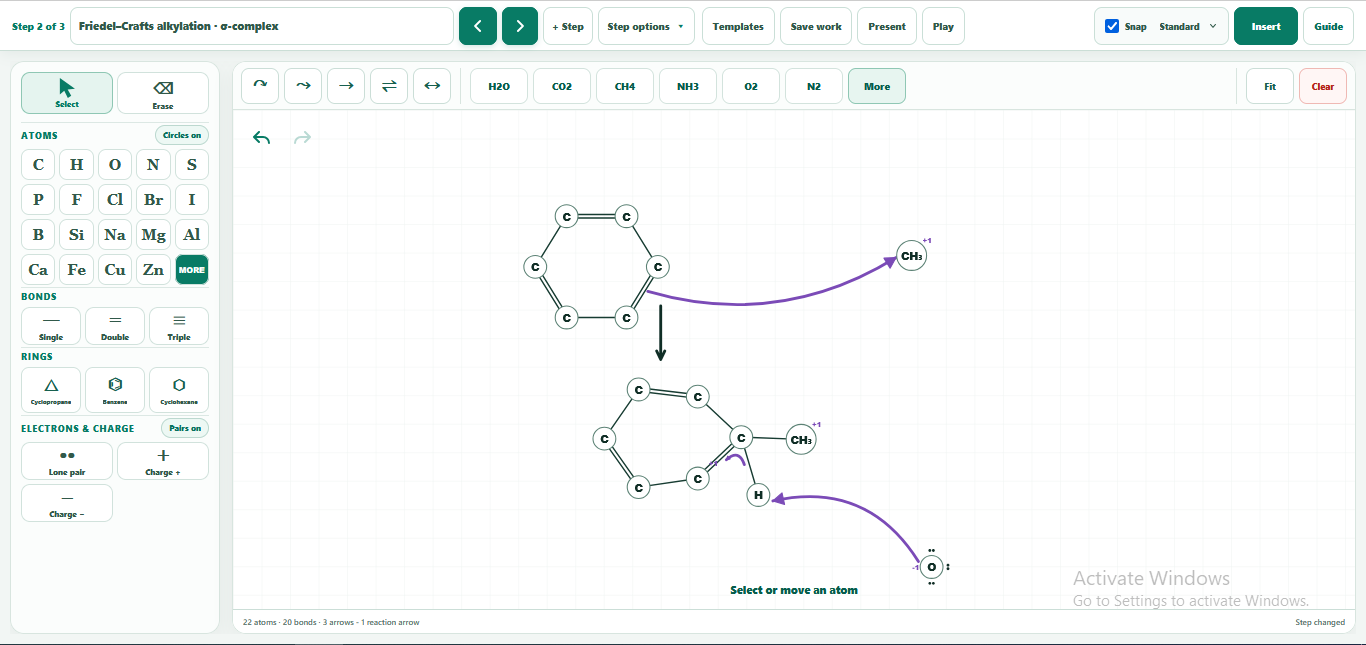
For individual learning only. Use for classroom teaching or commercial purposes is not permitted.
About this classroom tool
The Reaction Mechanism Board is an interactive resource designed to help teachers and students visualise and present organic reaction mechanisms clearly. It allows users to draw atoms, single, double and triple bonds, lone pairs, formal charges, and curved electron-flow arrows, which are essential for understanding how chemical reactions proceed.
This tool supports multiple mechanism stages, enabling step-by-step presentation of complex reactions. Users can add reaction conditions and play the sequence during lessons, making it easier to demonstrate the dynamic nature of organic chemistry processes. Built-in templates cover a wide range of reaction types including substitution, elimination, addition, carbonyl, aromatic, redox, acid–base, and radical reactions.
Key concepts
- Electron flow — curved arrows indicate the movement of electron pairs during reactions.
- Lone pairs — non-bonding electrons shown to explain reactivity and intermediates.
- Chemical bonds — single, double, and triple bonds represent connectivity between atoms.
- Reaction intermediates — transient species formed during multi-step mechanisms.
- Reaction conditions — factors such as temperature, solvents or catalysts influencing the reaction pathway.
- Stepwise mechanisms — breaking down complex reactions into sequential stages for clarity.
Using it in the classroom
- Starter activity: Introduce a reaction by drawing the initial reactants and predicting the first electron movements.
- Whole-class teaching: Demonstrate each step of a mechanism interactively, using the play sequence to show progression.
- Assessment for learning: Ask students to suggest the next step or identify intermediates during the mechanism presentation.
- Homework support: Provide screenshots or sequences for students to review or complete mechanisms independently.
- Group work: Use the board for collaborative drawing and discussion of reaction pathways.
Frequently asked questions
What types of reactions can I demonstrate with this board?
The board includes templates for substitution, elimination, addition, carbonyl, aromatic, redox, acid–base, and radical reactions, covering most common organic mechanisms.
Can I show multiple steps in a reaction mechanism?
Yes, the tool allows you to create and present multiple stages sequentially, helping students understand the stepwise nature of reactions.
How does the board help with understanding electron flow?
It uses curved electron-flow arrows to clearly indicate the movement of electron pairs, which is crucial for grasping how bonds break and form during reactions.
Is it suitable for all levels of chemistry students?
Yes, it is designed for all grades and can be adapted to different levels of complexity depending on the lesson focus.