Moon Phases Classroom Tool for Teaching Lunar Cycles
Discover how the Moon’s position creates its phases with an interactive tool showing lunar cycles, illumination, moonrise, and moonset for any location and time.
Want to teach with this content in Prezuva Slide?
Prezuva — Create, Teach, Engage, Assess
Try for free →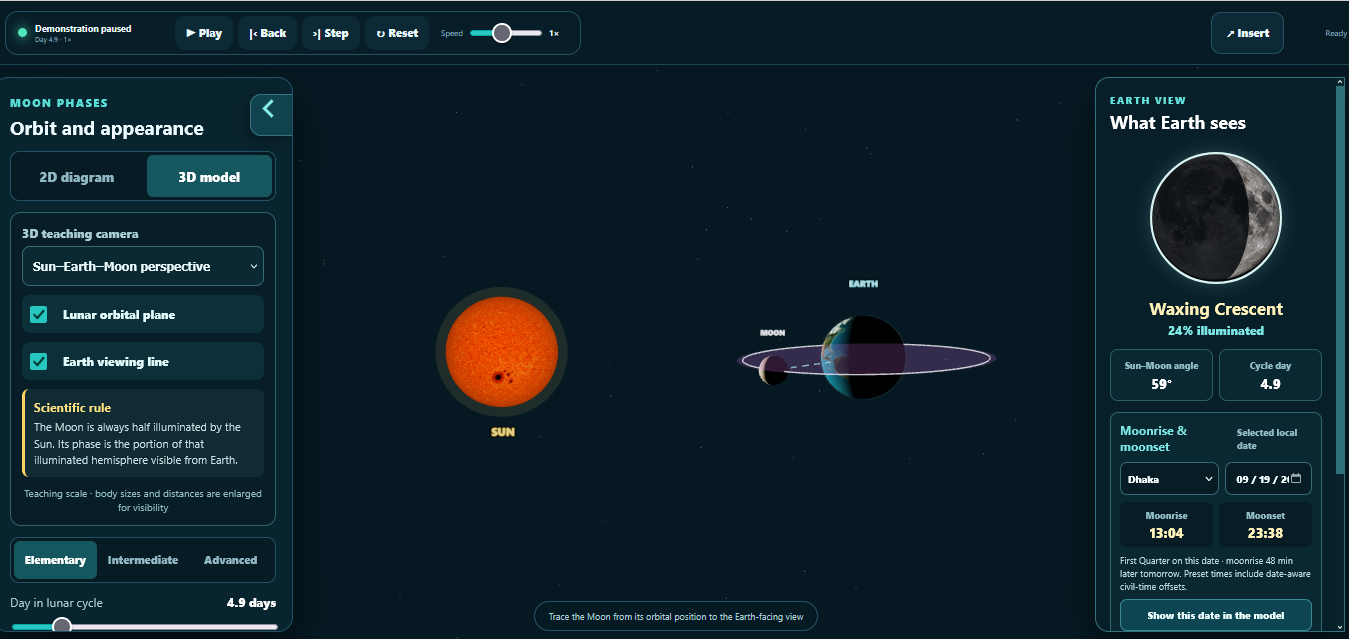
For individual learning only. Use for classroom teaching or commercial purposes is not permitted.
About this classroom tool
The Moon Phases classroom tool is designed to help students understand how the Moon’s changing position relative to Earth and the Sun produces its visible phases. By animating the lunar cycle, it visually demonstrates the progression from new moon to full moon and back, providing a dynamic way to explore this natural phenomenon.
This tool includes features that compare views from space and from Earth, showing the illumination of the Moon’s surface and how the phase angle changes throughout the cycle. Controls for location, date, and time allow students to connect the orbital model with real observations of moonrise, moonset, and the Moon’s position in the local sky.
Key concepts
- Lunar Cycle — the repeating sequence of Moon phases over approximately 29.5 days.
- Moon Phases — the visible shapes of the Moon caused by the changing angles of sunlight and the Moon’s position.
- Illumination — the portion of the Moon’s surface lit by the Sun as seen from Earth.
- Phase Angle — the angle between the Sun, Moon, and Earth that determines the Moon’s phase.
- Moonrise and Moonset — the times when the Moon appears above and below the horizon at a given location.
Using it in the classroom
- Starter activity: Animate the lunar cycle to introduce the phases and their sequence.
- Whole-class teaching: Use the space and Earth views to explain illumination and phase angle concepts.
- Assessment for learning: Have students predict moonrise and moonset times for different dates and locations.
- Homework: Assign observations of the Moon’s phase and position in the local sky to reinforce learning.
Frequently asked questions
Why does the Moon have phases?
The Moon’s phases result from its orbit around Earth, changing the angle at which sunlight illuminates the visible surface.
How long is a complete lunar cycle?
A full lunar cycle, from new moon to new moon, takes about 29.5 days, known as a synodic month.
Can the Moon be seen during the day?
Yes, depending on its phase and position, the Moon can often be observed in the daytime sky.
How do location and time affect moonrise and moonset?
Moonrise and moonset times vary with geographic location and date, which this tool allows you to explore interactively.