Interactive Periodic Table for Teaching All 118 Elements
Discover all 118 chemical elements with interactive features including atomic structure, electron configurations, and periodic trends to enhance science lessons.
Want to teach with this content in Prezuva Slide?
Prezuva — Create, Teach, Engage, Assess
Try for free →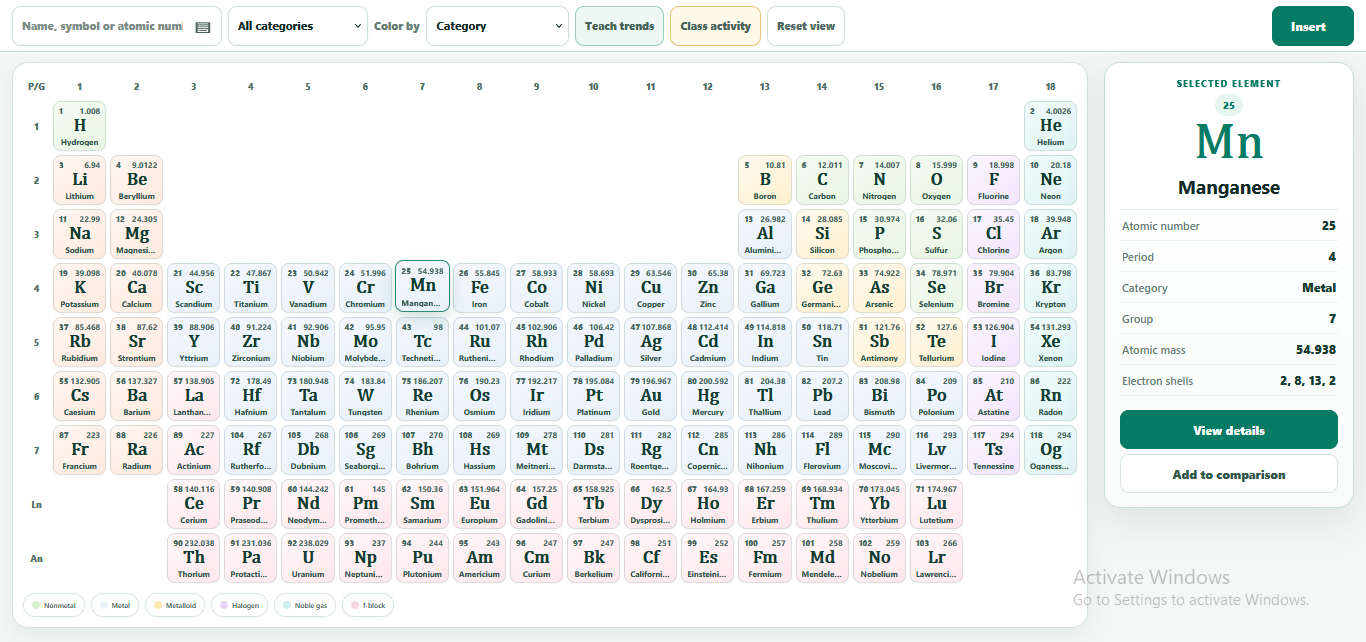
For individual learning only. Use for classroom teaching or commercial purposes is not permitted.
About this classroom tool
The periodic table is a fundamental resource in science education, organising all 118 known chemical elements based on their atomic number, electron configurations, and recurring chemical properties. This interactive classroom tool allows teachers and students to explore detailed information about each element, including atomic structure, electron shell diagrams, and isotopes.
By incorporating searchable data and category filters, the tool supports in-depth investigation of element groups such as metals, nonmetals, and metalloids, as well as specific families like alkali metals and noble gases. It also highlights periodic trends such as atomic radius and electronegativity, helping learners understand the underlying patterns in chemical behaviour.
Key concepts
- Atomic number — the number of protons in an element's nucleus defining its identity.
- Electron configuration — the arrangement of electrons in shells and orbitals around the nucleus.
- Periodic trends — predictable changes in element properties across periods and groups.
- Element categories — classification into metals, nonmetals, and metalloids based on properties.
- Isotopes and ions — variations of elements with different neutron numbers or electrical charge.
Using it in the classroom
- Use as a starter activity to review element names, symbols, and atomic numbers.
- Conduct whole-class lessons exploring periodic trends and element families.
- Set up interactive challenges where students identify elements based on properties or configurations.
- Assign homework tasks to research specific elements and their uses or bonding behaviour.
- Utilise the tool for assessment by asking students to compare elements and predict chemical reactions.
Frequently asked questions
What information can I find about each element?
You can explore atomic number, atomic mass, electron configurations, shell and orbital diagrams, ion forms, isotopes, and bonding tendencies.
How does the tool help with understanding periodic trends?
It visually presents trends such as atomic radius and electronegativity across periods and groups, making patterns easier to grasp.
Can this tool be used for all age groups?
Yes, it is designed to support learners of all ages by providing adjustable levels of detail suitable for different educational stages.
Are there interactive features for classroom engagement?
Yes, the tool includes searchable data, filters, and challenges to actively involve students in exploring the periodic table.