Eclipses: Understanding Solar and Lunar Phenomena
Explore solar and lunar eclipses by aligning the Sun, Earth and Moon. Learn about shadows, orbital tilt, and eclipse types with 2D and 3D classroom tools.
Want to teach with this content in Prezuva Slide?
Prezuva — Create, Teach, Engage, Assess
Try for free →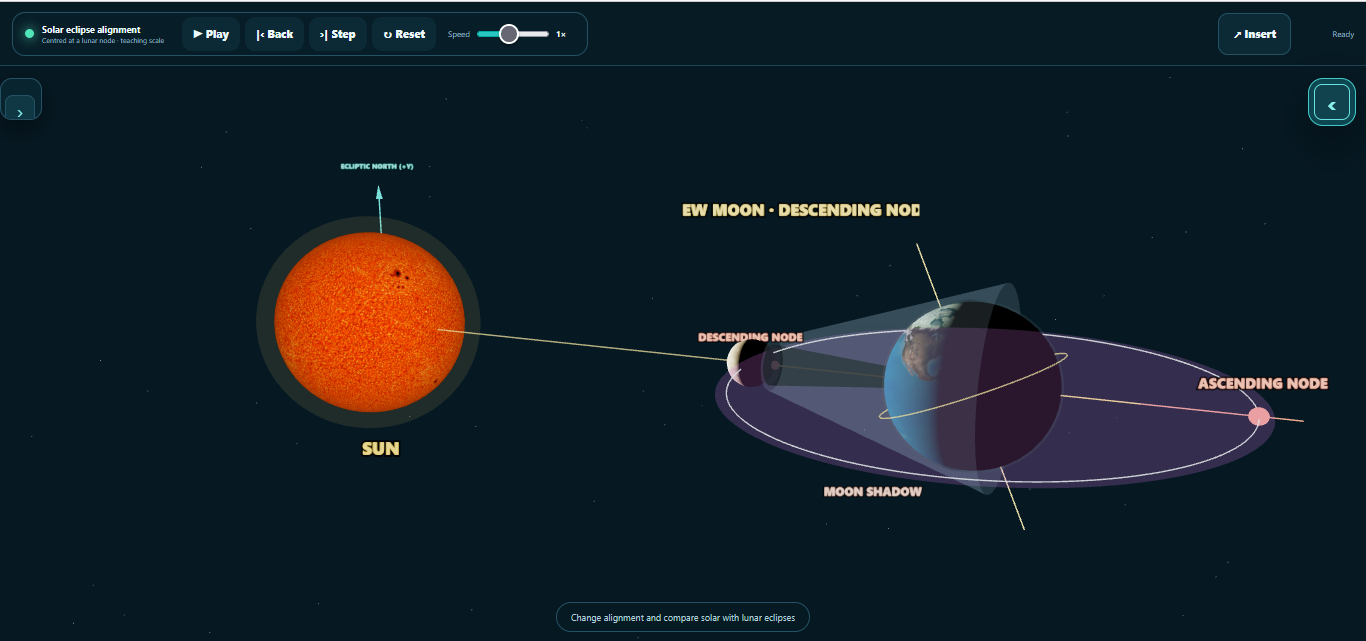
For individual learning only. Use for classroom teaching or commercial purposes is not permitted.
About this classroom tool
This classroom tool allows teachers and students to explore the fascinating phenomena of solar and lunar eclipses by visually aligning the Sun, Earth, and Moon. It demonstrates how the relative positions of these celestial bodies create different types of eclipses and the shadows involved.
By using both 2D and 3D visualisations, learners can investigate concepts such as orbital tilt, lunar nodes, and the stages of eclipse contact. This helps explain why eclipses do not occur every month despite the Moon orbiting the Earth regularly.
The tool also compares total, partial, and annular solar eclipses, enabling a deeper understanding of the variations in eclipse appearances and the paths of totality.
Key concepts
- Syzygy — the alignment of the Sun, Earth, and Moon during an eclipse.
- Umbra and Penumbra — the darkest and partial shadows cast during eclipses.
- Orbital Tilt — the inclination of the Moon's orbit causing eclipses to be infrequent.
- Lunar Nodes — points where the Moon's orbit crosses the Earth's orbital plane, essential for eclipses.
- Types of Solar Eclipses — total, partial, and annular eclipses with distinct visual effects.
- Eclipse Contact Stages — the phases marking the beginning and end of an eclipse.
Using it in the classroom
- Starter activity: Use the tool to demonstrate the basic alignment required for an eclipse and discuss everyday observations.
- Whole-class teaching: Explore the differences between solar and lunar eclipses using 3D visualisations for interactive learning.
- Assessment for learning: Ask students to predict eclipse types based on different alignments and explain their reasoning.
- Homework: Assign research on historical eclipses and their cultural significance, supported by the tool’s visuals.
- Group work: Have students model the orbital tilt and lunar nodes to explain why eclipses are not monthly events.
Frequently asked questions
Why don’t eclipses happen every month?
Eclipses are rare because the Moon’s orbit is tilted relative to the Earth’s orbit around the Sun, so the three bodies do not always align perfectly.
What is the difference between a total and an annular solar eclipse?
A total solar eclipse occurs when the Moon completely covers the Sun, while an annular eclipse happens when the Moon is too far away to cover the Sun fully, leaving a ring of sunlight visible.
What causes the different shadow types during an eclipse?
The umbra is the darkest part of the shadow where the Sun is completely blocked, the penumbra is a lighter shadow with partial coverage, and the antumbra appears during annular eclipses.
How can I use this tool to explain eclipse contact stages?
The tool visually demonstrates the moments when the Moon begins to cover the Sun, reaches maximum coverage, and moves away, helping students understand eclipse timing.