Explore Earth’s Interior with an Interactive Classroom Tool
Use an interactive cutaway model to explore Earth’s internal layers, including the crust, mantle, and core, examining their depth, composition, density, temperature, and physical state.
Want to teach with this content in Prezuva Slide?
Prezuva — Create, Teach, Engage, Assess
Try for free →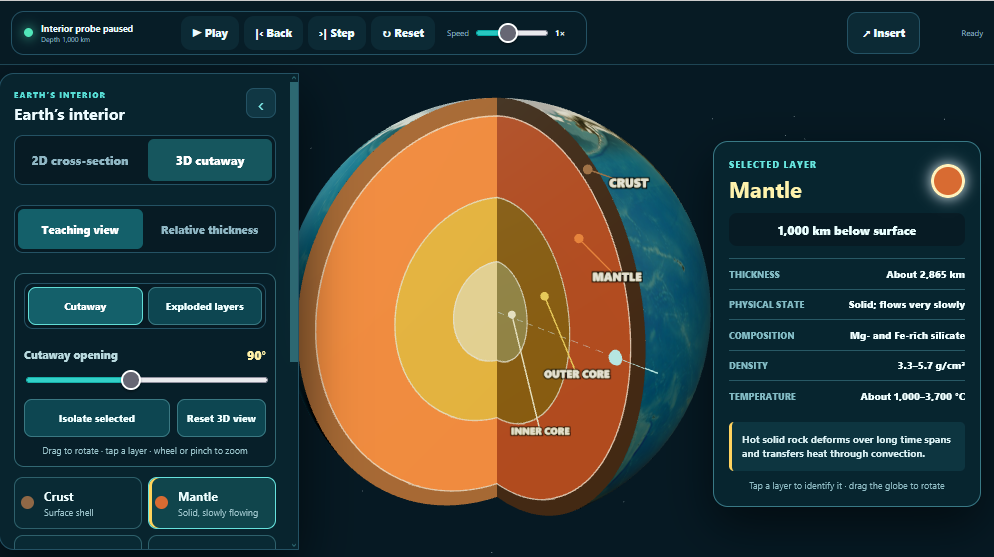
For individual learning only. Use for classroom teaching or commercial purposes is not permitted.
About this classroom tool
This interactive classroom tool offers a detailed exploration of Earth’s internal structure through a cutaway model. It allows students to select different layers of the Earth—such as the crust, mantle, and core—and examine key properties including depth, thickness, composition, density, temperature, and physical state.
By switching between views, learners can better understand the major boundaries within Earth’s interior, such as the Moho and the core-mantle boundary. This tool supports geography, earth science, and geology lessons by providing a visual and interactive way to study complex concepts about our planet’s inner layers.
Key concepts
- Crust — the outermost solid layer of Earth forming the surface we live on.
- Mantle — the thick middle layer composed of solid and semi-solid rock beneath the crust.
- Core — the innermost part, divided into a liquid outer core and solid inner core, responsible for Earth’s magnetic field.
- Physical states — Earth’s layers vary between solid and liquid states, influencing geological processes.
- Boundaries — major internal boundaries like the Moho and core-mantle boundary separate Earth’s layers.
Using it in the classroom
- Starter activity: Introduce Earth’s layers by exploring the model and identifying each layer’s characteristics.
- Whole-class teaching: Use the tool to demonstrate differences in composition and physical state between layers during lessons.
- Assessment for learning: Have students explain key features of each layer using the model as evidence.
- Homework: Assign students to research and report on one Earth layer, supported by observations from the interactive model.
Frequently asked questions
What are the main layers of Earth?
Earth is composed of three main layers: the crust, mantle, and core, each with distinct properties and composition.
How does the model show differences in physical state?
The model highlights solid and liquid layers, such as the solid crust and mantle versus the liquid outer core, helping students understand Earth’s internal dynamics.
Why is understanding Earth’s interior important?
Studying Earth’s interior helps explain geological phenomena like earthquakes, volcanism, and the planet’s magnetic field.