Day and Night: Understanding Earth's Rotation and Solar Time
Explore how Earth's rotation causes day and night, with interactive tools to examine sunlight, darkness, local solar time, and the day–night boundary for all ages.
Want to teach with this content in Prezuva Slide?
Prezuva — Create, Teach, Engage, Assess
Try for free →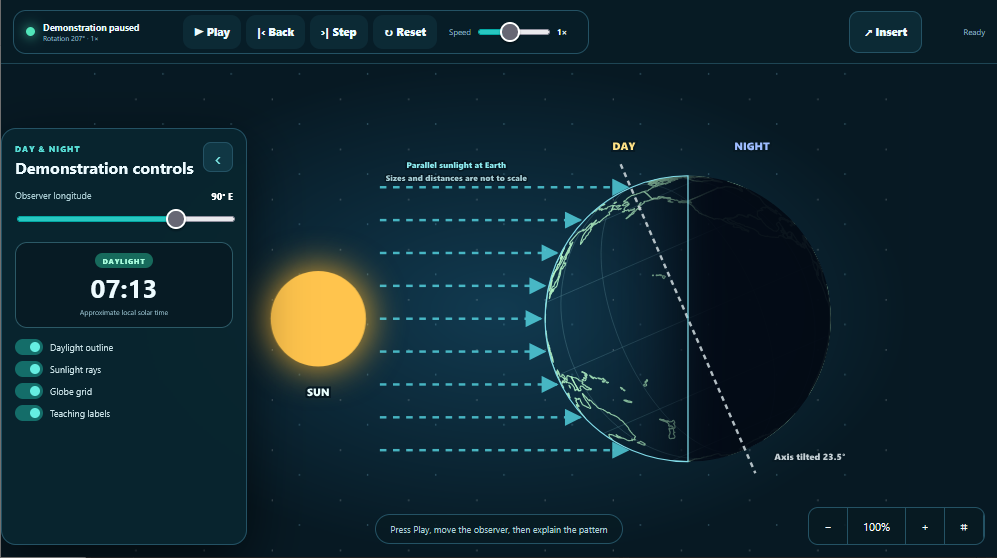
For individual learning only. Use for classroom teaching or commercial purposes is not permitted.
About this classroom tool
This classroom tool demonstrates how Earth's rotation on its axis produces the cycle of day and night. By animating Earth's rotation and allowing movement of an observer to different latitudes and longitudes, it helps visualise the changing patterns of sunlight and darkness across the globe.
It shows the day–night boundary, also known as the terminator, and illustrates local solar time at various locations. This interactive approach supports prediction and explanation stages in teaching, making complex concepts accessible for learners of all ages and abilities.
Key concepts
- Earth's rotation — the spinning of Earth on its axis causes the alternation of day and night.
- Day–night boundary (terminator) — the dividing line between the illuminated and dark halves of Earth.
- Local solar time — time based on the position of the Sun relative to a specific location's longitude.
- Latitude and longitude — coordinates that determine an observer's position on Earth, affecting sunlight exposure.
- Sunrise and sunset — the moments when the Sun appears or disappears at the horizon due to Earth's rotation.
Using it in the classroom
- Starter activity: Use the tool to show how day and night change over 24 hours, prompting students to predict times of sunrise and sunset.
- Whole-class teaching: Animate Earth's rotation to explain time zones and why different parts of the world experience day and night simultaneously.
- Assessment for learning: Ask students to identify local solar time for various locations and explain the position of the terminator.
- Homework: Assign students to observe sunrise and sunset times in their area and relate these to their longitude and latitude using the tool.
Frequently asked questions
Why does Earth experience day and night?
Earth's rotation on its axis causes different parts of the planet to face the Sun or move into darkness, creating the cycle of day and night.
What is the terminator line?
The terminator is the moving boundary between the day side and night side of Earth, marking where sunrise or sunset is occurring.
How does local solar time differ from standard time?
Local solar time is based on the Sun's position at a specific longitude, which can differ from standard time zones used for civil timekeeping.
How do latitude and longitude affect daylight?
Latitude influences the length of day and night throughout the year, while longitude determines local solar time and the timing of sunrise and sunset.