Conics Lab: Interactive Exploration of Circles and Parabolas
Explore circles, ellipses, parabolas and hyperbolas with interactive graphs and live equations, ideal for teaching conic sections in mathematics and engineering.
Want to teach with this content in Prezuva Slide?
Prezuva — Create, Teach, Engage, Assess
Try for free →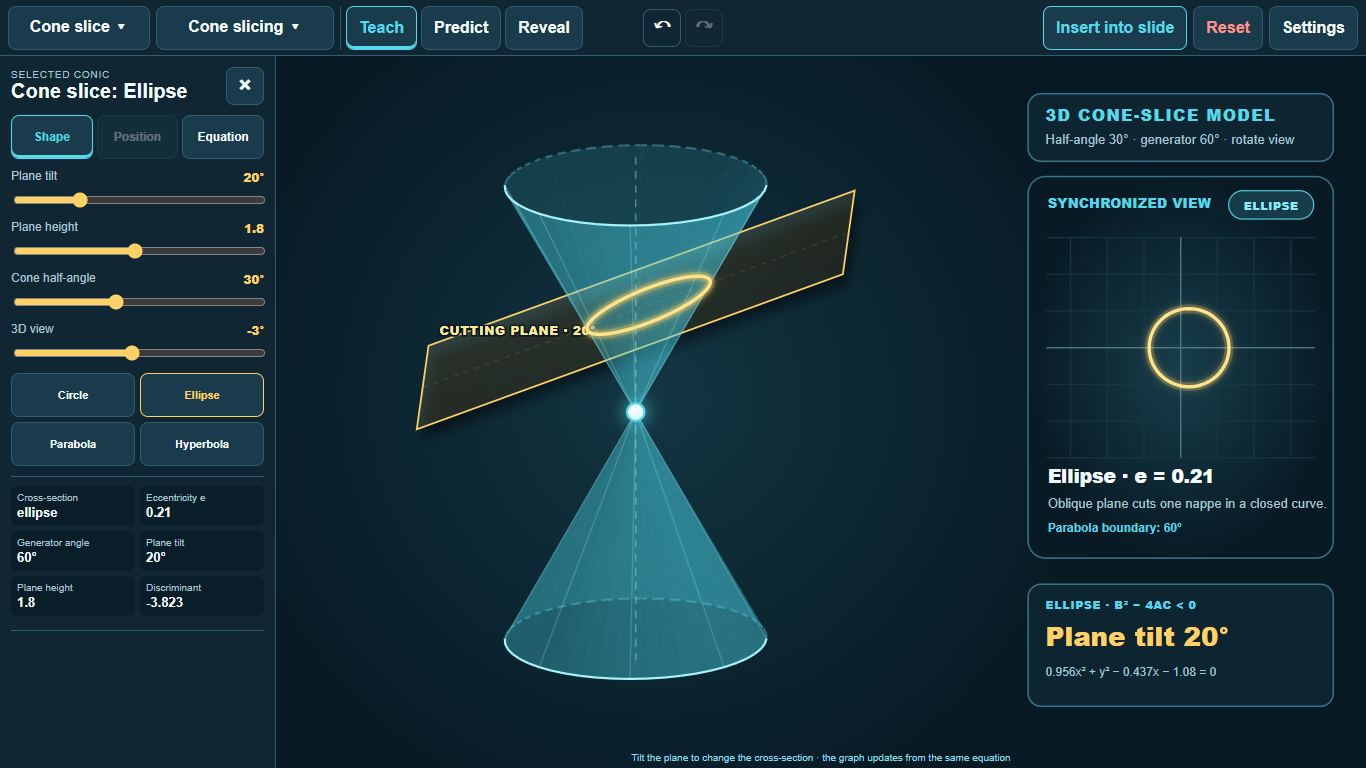
For individual learning only. Use for classroom teaching or commercial purposes is not permitted.
About this classroom tool
The Conics Lab is an interactive classroom tool designed to help students explore the fundamental shapes of conic sections: circles, ellipses, parabolas and hyperbolas. By combining dynamic graphs with live equations, it allows learners to visualise and manipulate these curves, deepening their understanding of their geometric and algebraic properties.
Originating from the study of slicing cones at different angles, conic sections are central to coordinate and analytic geometry. This tool supports teaching by demonstrating concepts such as eccentricity, foci, directrices and the relationship between quadratic equations and their graphs, making abstract ideas more accessible.
Key concepts
- Conic sections — curves formed by intersecting a plane with a double-napped cone.
- Eccentricity — a measure of how much a conic deviates from being circular.
- Focus and directrix — defining elements used to construct and analyse conics.
- Equation transformations — manipulating quadratic equations to understand conic shapes.
- Reflection properties — how parabolas and ellipses reflect light and sound.
Using it in the classroom
- Use the tool as a starter activity to introduce conic sections through visual exploration.
- Demonstrate the effect of changing parameters on the shape and position of conics during whole-class teaching.
- Assign students to investigate properties such as focal distances and eccentricity as homework tasks.
- Use interactive graphs for assessment for learning by having students predict and verify conic shapes from equations.
Frequently asked questions
What are conic sections?
Conic sections are the curves formed when a plane slices through a cone at different angles, resulting in circles, ellipses, parabolas or hyperbolas.
How does eccentricity affect the shape of a conic?
Eccentricity determines how stretched or circular a conic is; for example, a circle has eccentricity zero, while hyperbolas have eccentricity greater than one.
Can the Conics Lab help with understanding quadratic equations?
Yes, it links quadratic equations to their graphical representations, helping students see how changes in coefficients affect the shape of conics.
Why are reflection properties important in conics?
Reflection properties explain practical applications such as satellite dish design and optics, where parabolas and ellipses focus signals or light.