Circuit Lab: Interactive Tool for Teaching Electrical Circuits
Explore electrical circuits with Circuit Lab, a classroom tool for building, simulating, and analysing series and parallel circuits using meters, graphs, and live Kirchhoff’s-law analysis.
Want to teach with this content in Prezuva Slide?
Prezuva — Create, Teach, Engage, Assess
Try for free →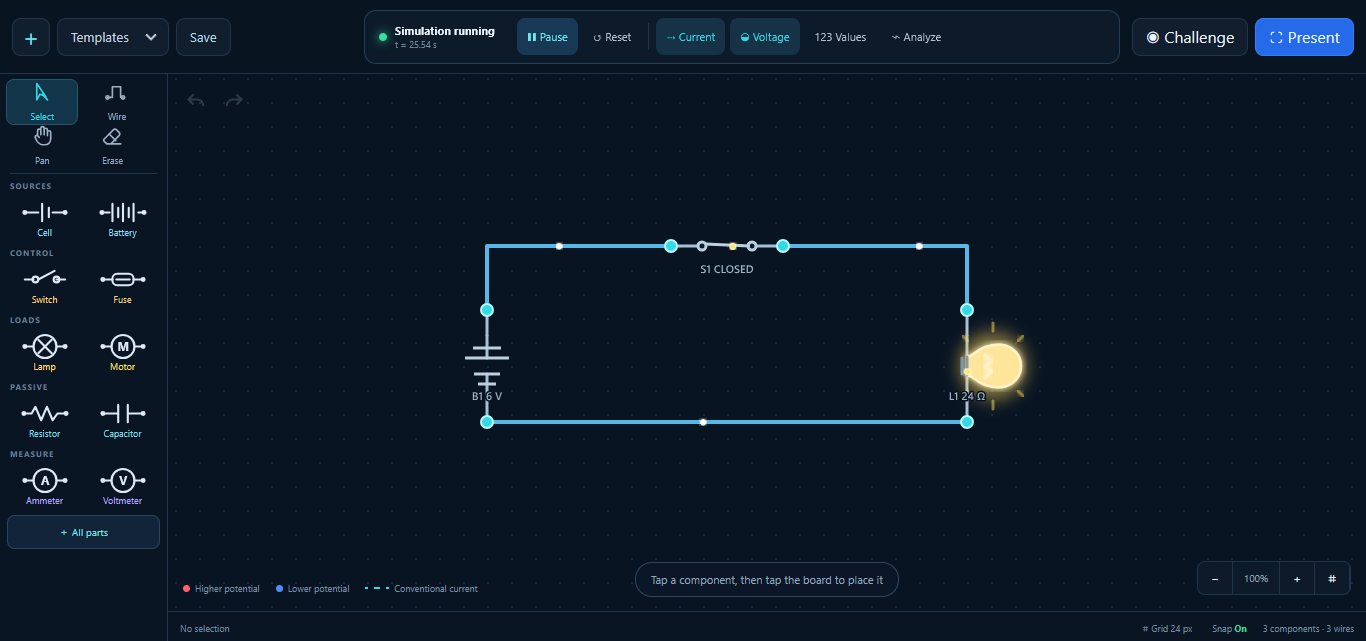
For individual learning only. Use for classroom teaching or commercial purposes is not permitted.
About this classroom tool
Circuit Lab is an interactive classroom tool designed to help teachers and students explore the fundamentals of electrical circuits. It allows users to build and simulate circuits by connecting and configuring a variety of electrical components such as batteries, resistors, switches, and lamps. This hands-on approach supports visual and practical learning in physics and engineering technology.
With Circuit Lab, students can observe key electrical properties like current and voltage in real time. The tool supports the study of both direct current (DC) and alternating current (AC) circuits, including series and parallel configurations. It also features meters, graphs, an oscilloscope, and live Kirchhoff’s-law analysis, enabling detailed investigation of circuit behaviour and reinforcing theoretical concepts.
Key concepts
- Series circuits — components connected in a single path affecting current flow sequentially.
- Parallel circuits — components connected across multiple paths, sharing voltage but dividing current.
- Ohm’s Law — relationship between voltage, current, and resistance in a circuit.
- Kirchhoff’s Laws — rules for current and voltage in complex circuits, including Kirchhoff’s Current Law (KCL) and Voltage Law (KVL).
- Electrical measurement — use of meters and oscilloscopes to monitor voltage, current, and power.
Using it in the classroom
- Starter activity: Build simple circuits to introduce concepts of current, voltage, and resistance.
- Whole-class teaching: Demonstrate series and parallel circuits with live simulation and measurement tools.
- Assessment for learning: Use circuit simulations to test student predictions about circuit behaviour and validate understanding.
- Homework task: Assign circuit design challenges to reinforce theoretical knowledge and practical skills.
- Experimentation: Encourage students to modify component values and observe effects on circuit performance.
Frequently asked questions
Can Circuit Lab simulate both DC and AC circuits?
Yes, Circuit Lab supports simulation of both direct current (DC) and alternating current (AC) circuits, allowing exploration of different electrical behaviours.
What components can be used in Circuit Lab?
The tool includes common electrical components such as batteries, cells, resistors, switches, fuses, lamps, and motors, enabling a wide range of circuit configurations.
How does the live Kirchhoff’s-law analysis help students?
It provides real-time calculations of current and voltage in circuits, helping students understand and verify Kirchhoff’s Current and Voltage Laws through interactive learning.
Is it possible to save and reuse circuit setups?
Yes, Circuit Lab allows users to save their circuit configurations for later use, supporting lesson planning and revision.